
Retinal and other retinoids have been the "gold standard" in skin care for years, but their introduction still causes a certain amount of uncertainty. Although we know how much they can help with irregularities, uneven complexion or signs of aging, many people wonder how to use them properly, how often to apply them and how to avoid redness, tightening or peeling of the skin. This is precisely why the introduction of retinal should not be sudden, but considered and adapted to the skin condition.

The big brother of the more famous retinol
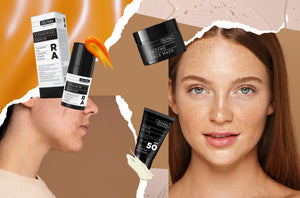
Vitamin serum RA is based on 0.1% pure encapsulated retinaldehyde, a strong form of retinoid that is proven to work against premature aging of the skin, as well as irregularities such as acne and pimples. Retinaldehyde in skin cells is converted into retinoic acid, its active and strongest form, which signals cells to accelerate renewal and stimulates collagen production. The result is a reduction in signs of aging, improved skin texture and an even complexion.
Unlike retinol, which must be converted to its active form in the skin in two steps (retinol → retinal → retinoic acid), retinal is converted directly to retinoic acid in one step, making it faster and more effective. This controlled conversion allows for a gradual and safer action of retinoic acid on the skin, reducing the irritation potential and facilitating the skin's adaptation to concentrated care. In this way, Vitamin Serum RA combines the powerful action of retinal with a minimal risk of redness, tightness or peeling of the skin.
The most potent retinoid with the mildest side effects
In addition to retinaldehyde, the serum contains bioidentical ceramides and their precursors, which correct damage to the hydrolipidic barrier of the skin, stimulate the synthesis of skin lipids and stimulate the skin's natural ability to regulate the level of hydration. The result is stronger, more resistant and long-term balanced skin. The formulation is additionally enriched with astaxanthin, one of the most powerful natural antioxidants. It is considered 10 to 100 times stronger than beta-carotene and lycopene, as well as vitamins C and E. Astaxanthin protects the skin from UV damage, promotes its renewal and acts against hyperpigmentation. It increases the ability of the skin to retain moisture by up to 40%, strengthens the elasticity, firmness and fullness of the skin and contributes to an even, fresh and shiny complexion. In synergy with retinaldehyde, it works against free radicals, visible hyperpigmentation and treatment spots.
The formulation is rounded off by bisabolol, allantoin and aloe vera , which additionally soothe, hydrate and protect the skin. Bisabolol increases the absorption of active substances, has a nourishing effect and can reduce irregularities in pigmentation. Allantoin modulates inflammatory processes, promotes skin renewal and healing, while aloe vera additionally calms and protects the skin.
Introduction phase
Retinal is used in the evening, on a clean and dry face. To begin, a small amount of serum, approximately the size of two pomegranate seeds, is applied, avoiding the eye area. This is followed by a light moisturizing cream or oil without other active ingredients (hyaluronic acid and peptides are the only exceptions). It is recommended to gradually introduce the serum into the routine so that the skin can monitor the effect and adapt to this active ingredient. In the first two weeks, it is optimal to use it every third evening, then gradually increase the use to every other evening. After the adaptation phase and gradual introduction, it is possible to use the serum every day, if the skin suits it. It is important to observe the skin's reaction, and the frequency can be gradually increased depending on the skin's needs and resistance. For sensitive skin or when first introducing retinoids, it is recommended to use the buffering technique. This technique involves applying a neutral nourishing cream, then serum, and then cream and/or oil again, to reduce potential irritation. This gradual approach allows the skin to gradually adapt to retinal, reducing the risk of redness, tightness or peeling. When using retinal, as with acids, SPF protection is mandatory in the morning routine. In the morning, the cream can be replaced with Professional Face Fluid SPF 50 .

Adaptation phase
Once the skin has become accustomed to this ingredient, other ingredients can be incorporated into the routine, depending on the skin's needs. The key is to gradually incorporate new steps. In the morning, it is best to focus on hydration and skin protection, so before SPF, it is recommended to use products such as Hydro Toner and/or Hyaluron Hydrator 4H , which deeply moisturize the skin and prepare it for daily protection. In the evening routine, it is important to choose a cream that is soothing enough, with a good ratio of emollients and humectants, to hydrate and nourish the skin, while not interfering with the action of retinoids. An example of such care is Amino Activator CM , a light cream based on azeloglycine, amino acids and the CM molecule that effectively soothes the skin. Occasionally, a hydrating mask, such as the Hydro CICA Face Mask, can be added for additional renewal and care. If acids or other exfoliants are used in the routine, it is important that they are not applied simultaneously with retinal in the same evening, but on different days. New ingredients are introduced gradually, one at a time, with careful observation of the skin's reaction. In case of redness, irritation or peeling, it is recommended to return to the basic routine with an emphasis on restoring the skin barrier and hydrating the skin.